Solar Estimator
Product Design + Web Development
Description
A homeowner types their average monthly power bill and reads back the system an installer would actually quote — size in panels, upfront cost, the monthly saving, and when it pays itself off. Under a minute, honest NZ numbers, and not a single phone call. The kind of tool that turns a solar installer's website from a brochure into a lead machine.
Client
PAAK — internal
Year
2026
Services
Product Design + Web Development
Numbers
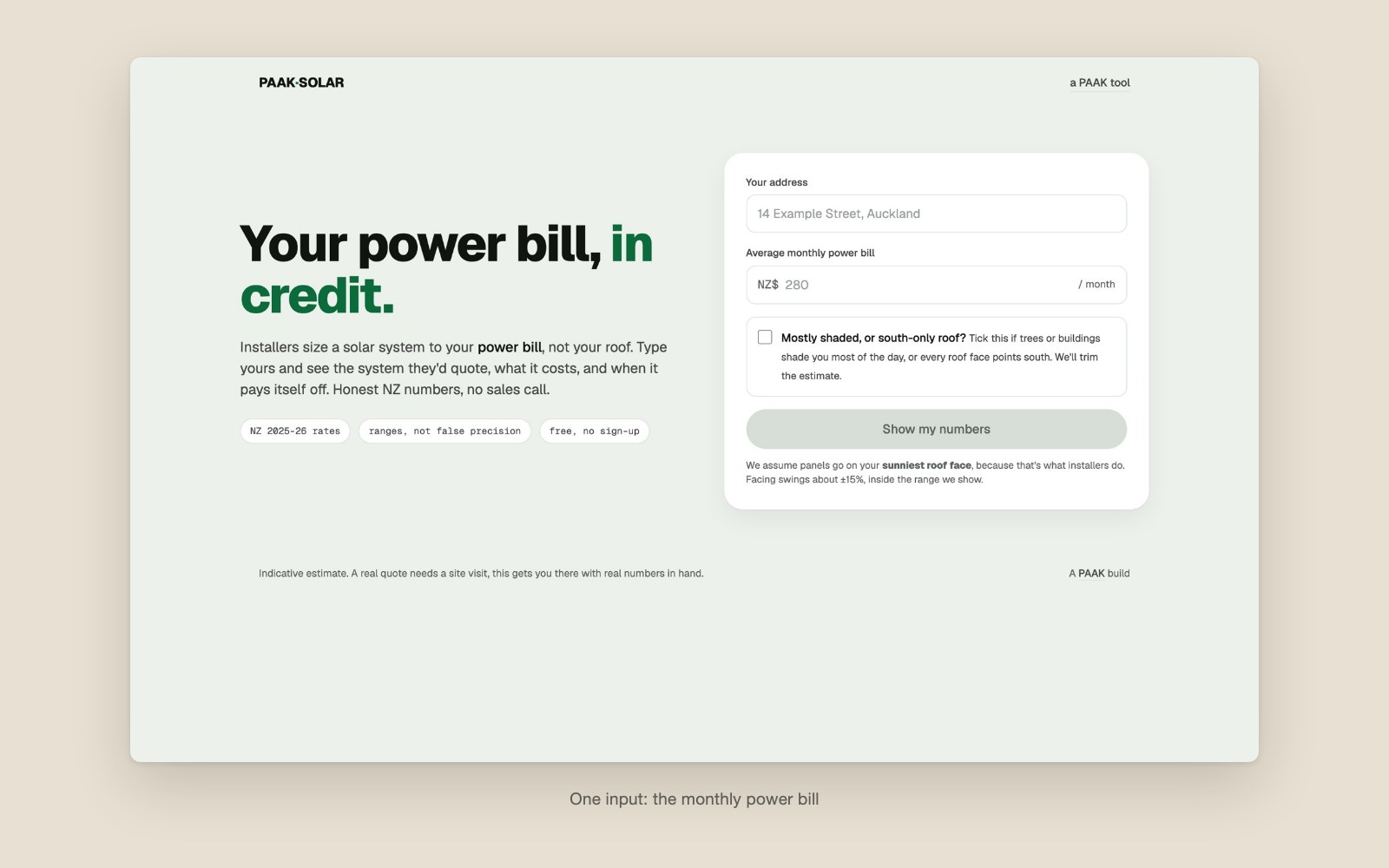
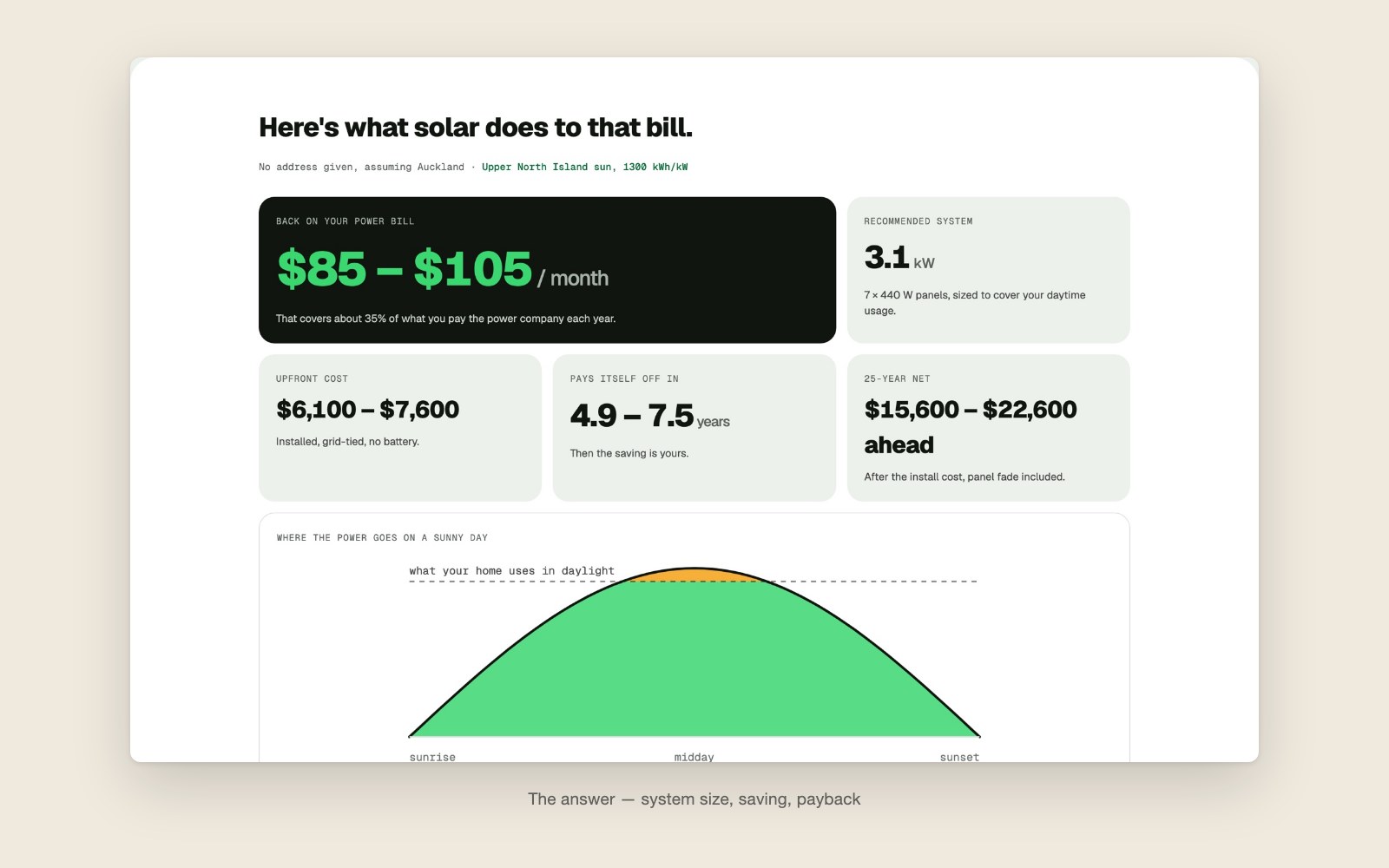
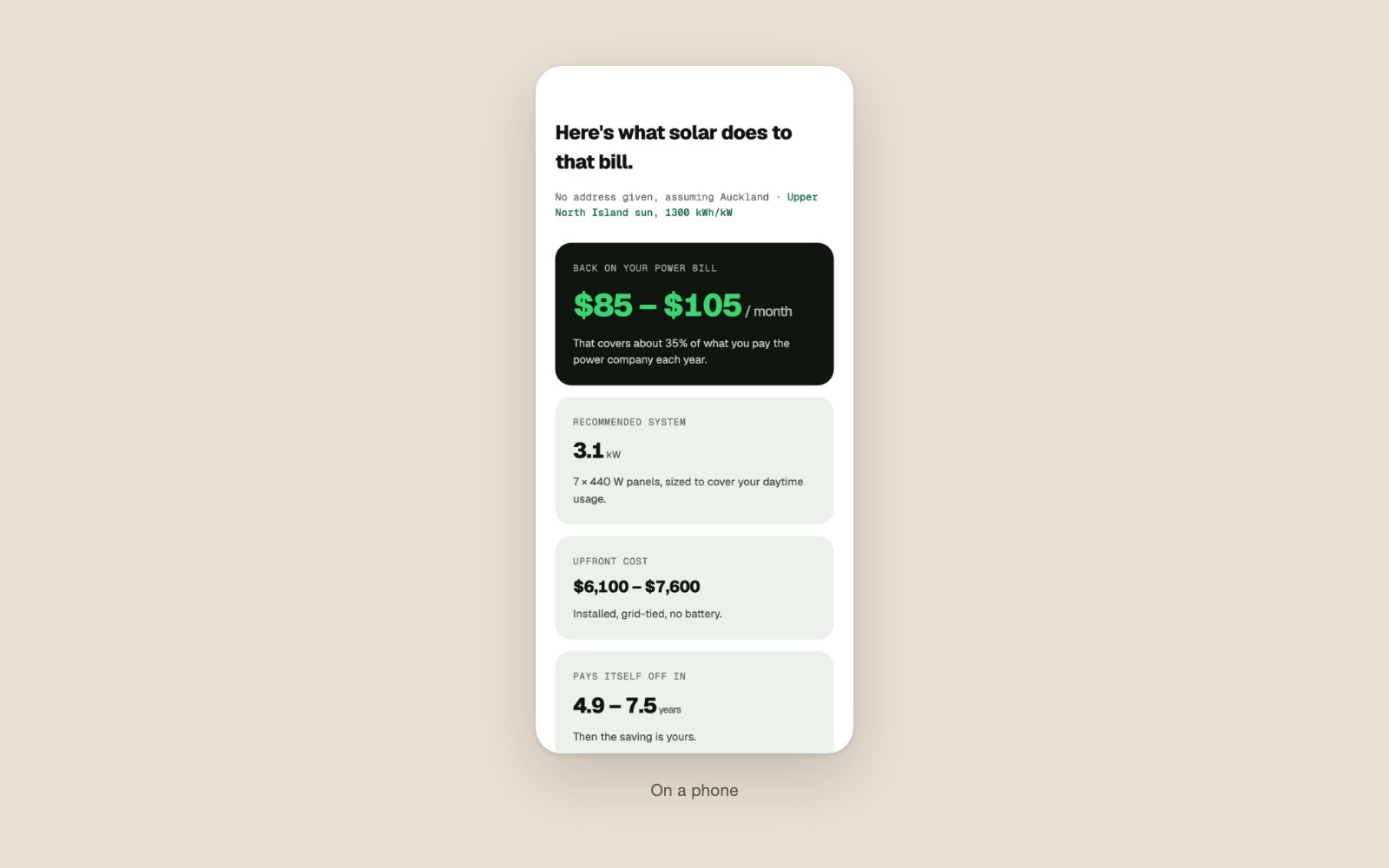
Type your average monthly power bill and read back system size, cost, monthly saving and payback — no form-fill wait, no sales call.
Power you use yourself is worth retail (~30c/kWh); power sold back earns ~12c. Every number on the page respects that split — most calculators quietly don’t.
Upper North Island to the deep south, each on its own kWh-per-kW band — an Auckland roof and a Dunedin roof get different answers, as they should.
The long answer, panel fade included: what the system puts you ahead over its life, after the install cost, shown as a range — never false precision.
The problem
Most solar calculators start with the roof — trace it, measure it, cover it in panels — and quote the biggest system that fits. But that's not how installers actually size a system. They size it to the power bill, because power you can't use yourself earns a quarter of what power you use is worth.
So the honest tool starts where the installer starts: the bill. Get that right and the roof is just a fit-check at the end.
What we did
BILL-FIRST SIZING
Type the monthly bill and the tool sizes the system the way an installer would — enough panels to cover daytime usage, not enough to dump cheap surplus into the grid. Address is optional and only sharpens the sun-yield band.
THE SUNLIGHT SPLIT, DRAWN
A day-curve chart draws itself on answer: the generation you use yourself floods green (worth retail), the sliver you export goes amber (worth buyback). The one economics lesson every solar buyer needs, in a single picture.
HONEST NZ 2025–26 MODEL
Current 440 W panels, real installed rates by system size, latitude sun-yield bands, retail vs buyback pricing, and panel fade over 25 years. Every assumption is shown on the page, and every output is a range — an indicative estimate, and it says so.
A LEAD, NOT A DEAD END
An optional satellite check lets the visitor trace a roof face to confirm the panels fit — it never gates the answer. Forked per installer with their branding and a contact capture, it drops a warm, already-sized lead into their inbox.
Model: 440 W panels sized to daytime usage (35% daytime share), NZ latitude sun-yield bands 1120–1300 kWh/kW·yr, retail $0.30/kWh vs buyback $0.12/kWh, installed cost $2,200→$1,450 per kW as systems scale, panel fade included in the 25-year net. Outputs are indicative ranges — a firm quote needs a site visit, and the tool says so. Satellite imagery © Esri, Maxar, Earthstar Geographics. The clip is a real run of the live tool.
More work